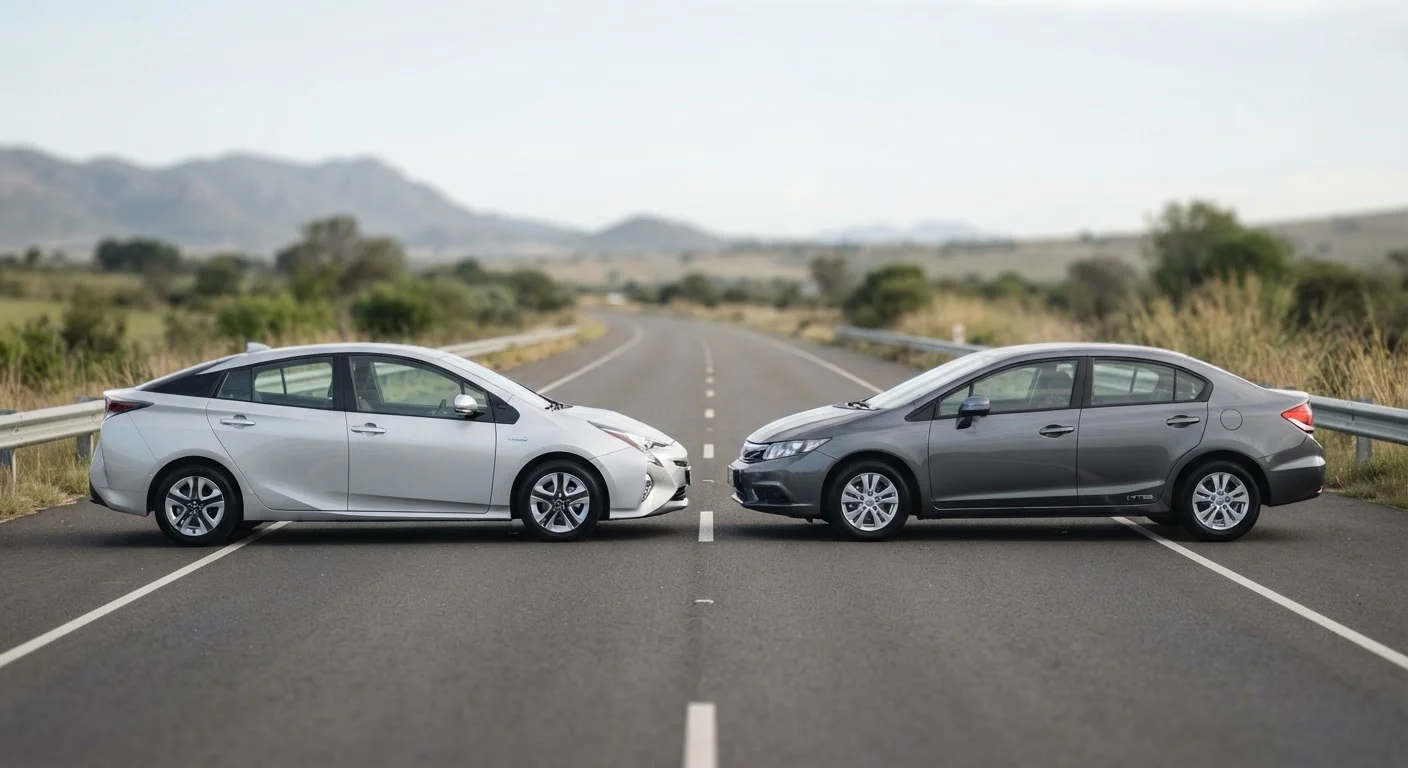
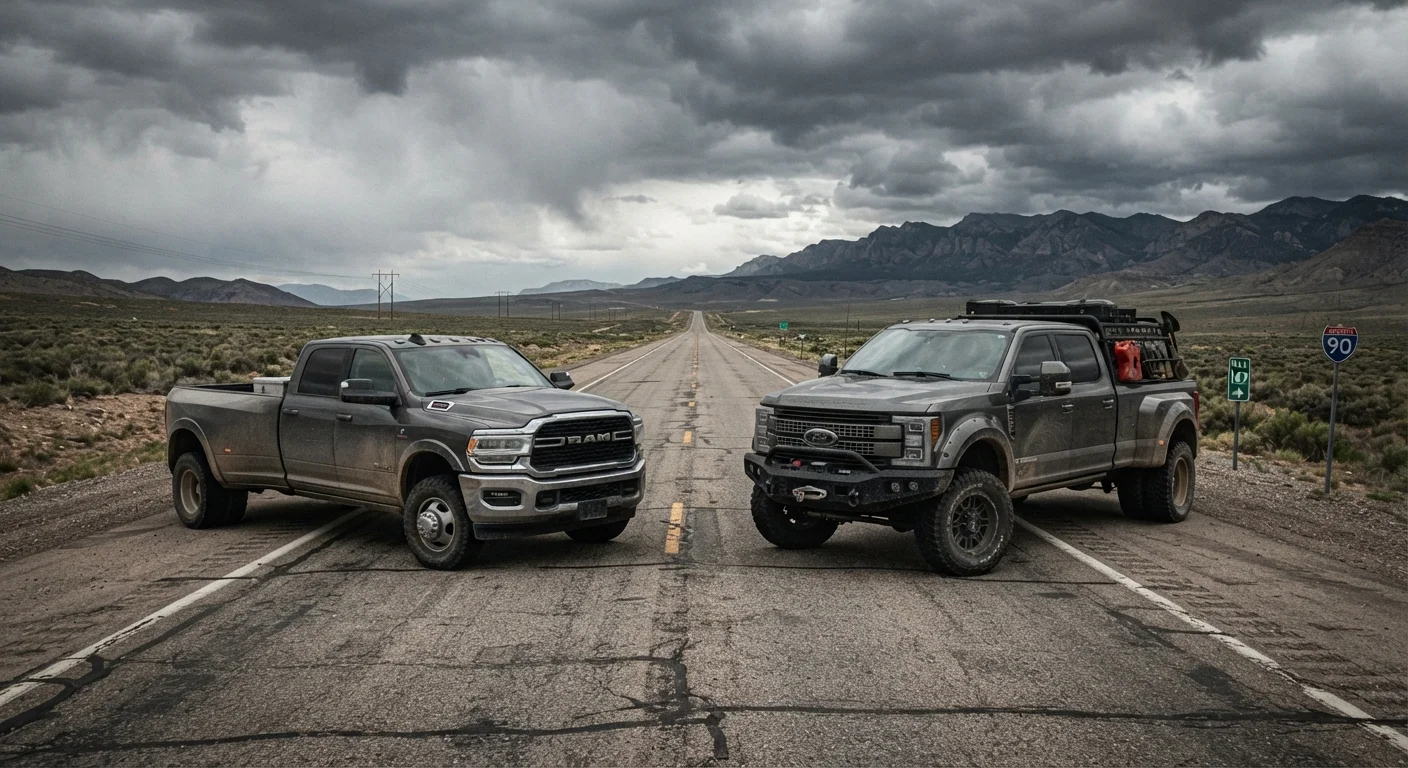
Why the Names No Longer Mean What They Say
The "half-ton" and "three-quarter-ton" designations trace back to post-war payload classifications that haven't reflected reality for decades. A modern half-ton can haul well over 2,000 lbs in the bed; a 2500-series truck routinely handles payloads above 3,500 lbs. What the labels do communicate, reliably, is a fundamental difference in engineering intent - and that's where the comparison gets interesting.
Gross Vehicle Weight Rating (GVWR) - the maximum a truck can weigh fully loaded, including passengers, cargo, and tongue weight - is the more meaningful dividing line. Half-tons typically carry GVWRs in the 7,000-8,500 lb range; ¾-ton trucks generally run 9,900-11,500 lbs. That gap isn't marketing: it reflects heavier frame rails, larger axle shafts, higher-capacity brakes, and stiffer rear spring packs engineered into the 2500-series from the ground up. For context on which specs actually translate into real-world capability, see which capability metrics carry the most weight.
Structural and Mechanical Differences That Actually Matter
The 2500-series frame is not a half-ton frame with a higher sticker price. It uses heavier-gauge steel, wider track widths in many configurations, and - critically - solid rear axles across virtually the entire lineup. Many half-tons, by contrast, have moved to independent rear suspension (IRS), which delivers a vastly more comfortable unladen ride but limits the axle-to-frame load path that heavy towing demands.
Brake systems scale accordingly. Three-quarter-ton trucks run larger rotors and higher-capacity calipers to manage the kinetic energy of a loaded trailer that could weigh as much as the truck itself. Transmission coolers, transfer case ratings, and hitch receiver specifications are also uprated on the 2500-series - not as options, but as baseline engineering.
| Criterion | Half-Ton (1500-Series) | Three-Quarter-Ton (2500-Series) |
|---|---|---|
| Typical GVWR range | 7,000-8,500 lbs | 9,900-11,500 lbs |
| Maximum tow rating (approx.) | Up to ~14,000 lbs | Up to ~20,000+ lbs |
| Rear suspension type | IRS or solid axle (varies) | Solid rear axle (standard) |
| Hybrid powertrain availability | Yes (select models) | Not widely available |
| Unladen ride comfort | Smoother, more compliant | Stiffer, more utilitarian |
| Fuel economy (general) | Higher (lighter platform) | Lower (heavier drivetrain) |
| Frame construction | Lighter-gauge steel | Heavier-gauge steel rails |
| Ideal use profile | Mixed daily use and moderate towing | Heavy towing and sustained hauling |
Engine selection diverges here too. While half-tons now offer turbocharged V6s, small-displacement V8s, and hybrid powertrains, the ¾-ton's most capable configurations lean heavily on high-torque diesel engines - a trade-off covered in depth in our look at diesel versus gasoline engines in heavy-duty trucks.
Towing and Payload: Where the Ceiling Diverges Sharply
The most consequential practical difference is the towing ceiling. A well-equipped half-ton can approach 13,000-14,000 lbs of maximum tow rating, which is genuinely impressive. But the ¾-ton's structural ceiling - commonly 18,000-20,000+ lbs depending on configuration - is simply inaccessible to the lighter platform. That gap matters enormously for anyone pulling a large fifth-wheel RV, a loaded horse trailer, or heavy equipment.
~14,000 lbs
Peak tow rating for top half-ton configurations
Manufacturer-published maximum tow ratings for leading 1500-series trucks with maximum towing packages, per publicly available spec sheets.
20,000+ lbs
Maximum tow rating for capable ¾-ton configurations
Several 2500-series trucks with diesel engines and gooseneck hitch setups publish ratings exceeding 20,000 lbs in manufacturer specifications.
~35%
Approximate GVWR advantage of ¾-ton over half-ton
Calculated from typical published GVWR ranges across the 1500 and 2500 truck classes; individual configurations vary.
Payload tells a similar story. Running a half-ton at or near its rated limit is permissible; running it over that limit creates a safety and legal exposure that no amount of anecdotal "I do it all the time" normalizes. The ¾-ton's higher payload rating provides a meaningful buffer - critical for commercial operators or anyone loading the bed with dense materials like gravel, concrete blocks, or livestock feed regularly.
Bed and cab configurations interact with these ratings in ways that aren't always obvious. A longer bed on a ¾-ton changes the towing geometry for fifth-wheel hitches significantly - a consideration explored in detail in our article on truck bed configurations and how cab style interacts with cargo capacity.
Daily Driving Trade-Offs: Comfort, Economy, and Size
Three-quarter-ton trucks demand trade-offs away from the worksite. The stiff rear suspension that makes sustained towing manageable becomes punishing on an empty bed over rough pavement - a characteristic every ¾-ton owner learns to live with. Fuel economy penalties are real: heavier drivetrains and larger displacement engines push fuel costs measurably higher, particularly in stop-and-go conditions. Parking and maneuverability in urban environments also tip against the larger platform, which often runs several inches longer and wider than equivalent half-tons.
Half-tons have narrowed the utility gap considerably. Modern 1500-series trucks are far more capable than their predecessors, and rating creep - where successive generations gain payload and tow capacity - has continued steadily. For a grounded look at how dramatically ratings shift across model years, the article on common missteps when comparing trucks across model years is a useful corrective. Still, for buyers whose workload genuinely lives at the heavy end of the spectrum, the half-ton's comfort advantages don't offset the capability shortfall. The honest question isn't which truck is better - it's whether your actual use case requires what the ¾-ton uniquely delivers.