
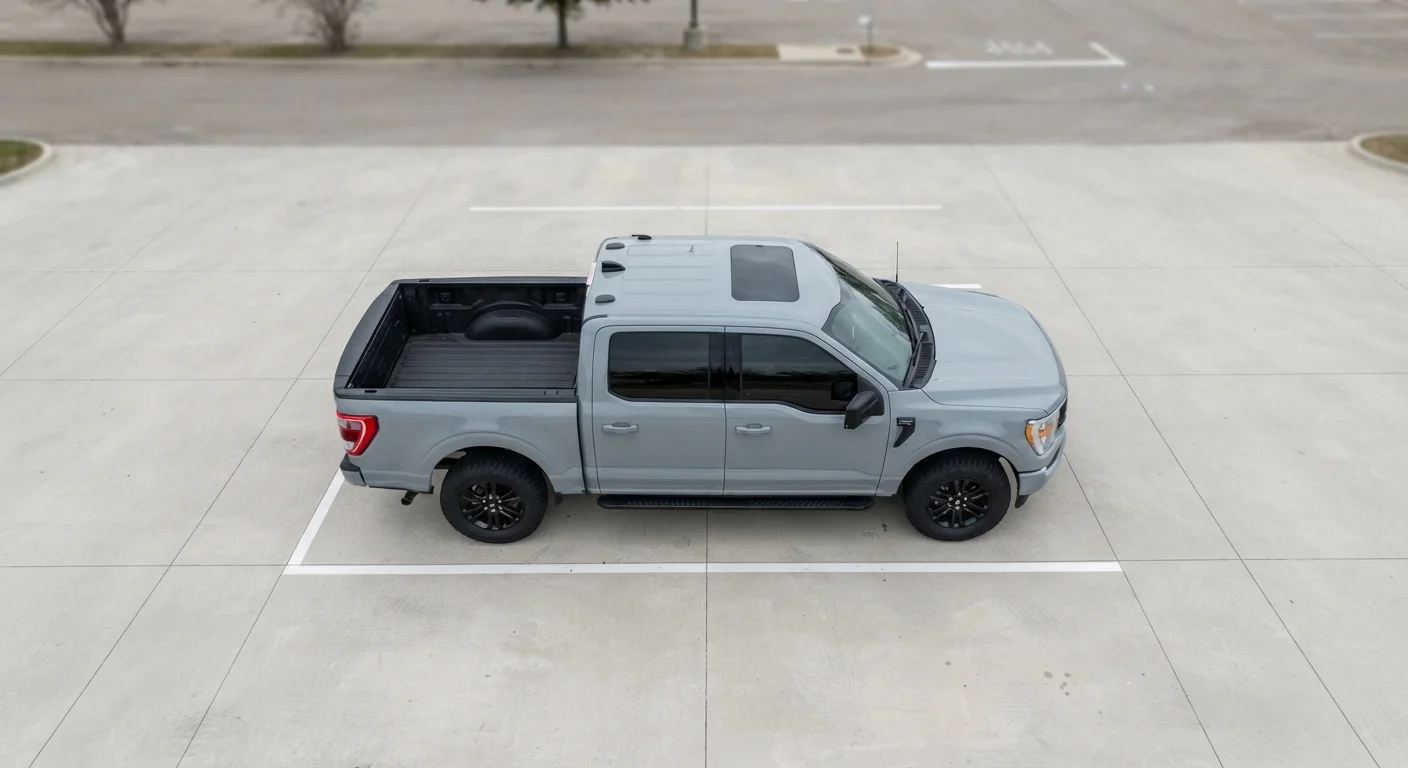
The Three Variables That Define a Truck's Layout
When configuring a pickup truck, buyers face three interlocking decisions: cab style, bed length, and - less obviously - how the two interact with overall vehicle footprint. These aren't cosmetic choices. They determine how much cargo you can carry, how a trailer tracks during towing, and whether the truck fits a standard parking space or garage bay.
| Regular cab bed length (full-size) | Up to ~8 ft (Varies by manufacturer platform) |
| Crew cab standard bed length (full-size) | ~5.5-6.5 ft depending on model (Varies by manufacturer platform) |
| Most popular U.S. cab style | Crew cab (Consistently dominant in U.S. full-size truck sales mix) |
| Typical crew cab + long bed overall length | ~22+ feet (Approximate; varies by platform) |
| Wheelbase effect on towing | Longer wheelbase = more stable trailer tracking (General towing engineering principle) |
| Payload rating location | Door-jamb sticker (vehicle-specific) (Required by U.S. federal regulation) |
Cab styles generally fall into three categories. A regular cab (sometimes called a standard cab) offers one row of seating and the longest available bed for a given wheelbase. An extended cab (variously called SuperCab, Double Cab, or Access Cab depending on manufacturer) adds a second row - typically accessed through rear-hinged or smaller rear doors - but compresses bed length relative to a regular cab on the same platform. A crew cab (or SuperCrew, Crew Max, etc.) provides full-size rear doors and a genuine second-row passenger space, but comes with the shortest standard bed option on most platforms.
Bed lengths vary by segment. Full-size trucks typically offer short beds (~5.5-5.8 ft), standard beds (~6.5 ft), and long beds (~8 ft). Midsize trucks tend to top out around 6 ft. For a broader look at how platform size affects capability across segments, see full-size vs. midsize trade-offs.
How Cab and Bed Combine: The Wheelbase Effect
Manufacturers hold overall vehicle length roughly constant within a platform by trading cab length against bed length. Choose a crew cab and you gain rear passenger space; the bed shrinks accordingly. This isn't arbitrary - wheelbase (the distance between front and rear axles) is a fixed engineering variable for each platform trim. What changes is how that wheelbase is divided between cab and cargo area.
Wheelbase has direct consequences for towing geometry. A longer wheelbase reduces the angular difference between tow vehicle and trailer during turns - colloquially, the rig tracks more stably. A crew cab with a short bed on a shorter wheelbase can introduce more sway than the same powertrain paired with a long bed on an extended wheelbase. If fifth-wheel towing is part of your use case, bed length also determines pin clearance during tight turns - a critical safety constraint. Sizing a truck for fifth-wheel trailers covers pin weight and bed length interaction in detail.
Wheelbase
The distance measured between the centers of the front and rear axles. Longer wheelbase generally improves towing stability and ride quality but increases the truck's turning radius and parking footprint.
Payload capacity
The maximum weight a truck can carry in its cab and bed combined, as rated by the manufacturer. This figure is posted on the door-jamb sticker and accounts for passengers, cargo, and any added accessories.
Short bed
A truck bed approximately 5.5 to 5.8 feet long. Common on crew cab configurations; limits the ability to carry full-length sheet goods flat in the bed without overhang.
Gross Vehicle Weight Rating (GVWR)
The maximum allowable total weight of a fully loaded vehicle - including the truck itself, fuel, passengers, and cargo. Exceeding GVWR affects safety, braking, and may void warranty coverage.
Pin clearance
In fifth-wheel towing, the space between the front of the trailer and the cab during turns. Crew cab trucks with short beds may have insufficient pin clearance, creating a safety hazard on tight curves.
Crew cab
A cab configuration featuring full-size front and rear doors and a complete second row of seating. Typically paired with a shorter bed on the same platform compared to regular or extended cab variants.
Payload capacity - how much weight the truck can carry in the bed and cab combined - is set by the suspension and axle ratings, not bed volume alone. A long bed does not automatically raise payload; it adds cargo floor area. Buyers sometimes conflate bed volume with payload, which are separate specifications found on the door-jamb sticker.
Real-World Trade-Offs by Configuration
Below is a practical breakdown of how common configurations behave across key use cases:
- Regular cab + long bed: Maximum cargo length for sheet goods, lumber, or equipment. Minimal passenger accommodation. Longest overall footprint - challenging in urban environments. Increasingly rare in consumer segments.
- Extended cab + standard bed: A balanced configuration that retains useful bed length (typically 6.5 ft) while offering occasional rear seating. Good all-around profile for buyers who haul more than they transport passengers.
- Crew cab + short bed: The most popular configuration in the U.S. market. Prioritizes passenger comfort; the ~5.5 ft bed limits full sheet-good capacity without a bed extender. See how bed extenders and cargo accessories interact for options that partially compensate.
- Crew cab + long bed: Maximum capability in both passenger and cargo dimensions, but overall length often exceeds 22 feet. Towing geometry is typically the most stable of any consumer-market configuration. Parking and maneuverability trade-offs are significant.
~8 ft
Long bed length on full-size trucks
Long beds accommodate full 4×8 sheet goods flat without overhang, a capability short beds cannot match.
~22+ ft
Overall length, crew cab + long bed
This combined configuration often exceeds standard parking space dimensions, a meaningful daily-use trade-off.
6.5 ft
Standard bed - common middle-ground length
The 6.5 ft bed is frequently cited as balancing cargo utility with manageable vehicle length on full-size platforms.
Structural architecture also matters here. Body-on-frame trucks handle the stress of combined payload and towing loads differently than unibody platforms. Body-on-frame vs. unibody construction explains why this affects maximum capability ratings. For buyers mapping these configurations to a broader ownership framework, a utility-focused decision framework provides useful structure.
This article is for general informational purposes. Payload, towing, and dimension specifications vary by manufacturer, model year, and trim. Always verify figures against the manufacturer's published data and the vehicle's door-jamb label before making a purchase decision.