Why the Truck vs. SUV Question Is Worth Asking Carefully
Most buyers approaching this category anchor their thinking on occasional, high-demand tasks - hauling a boat once a season, navigating a muddy trail on a camping trip - while underweighting the 95% of miles driven on highways and suburban roads. That bias consistently pushes buyers toward more capability than they need, or toward the wrong type of capability entirely.
The truck and SUV segments have also converged in ways that make surface-level comparisons misleading. Many full-size SUVs share a platform, frame, and powertrain with a corresponding pickup. Others - crossover SUVs built on car platforms - are engineering fundamentally different products. Understanding where a given model sits on that spectrum is the starting point for any honest evaluation.
This framework is designed to cut through that noise by grounding the analysis in use cases, verified specifications, and ownership economics - not trim-level marketing.
Mapping Your Real-World Use Cases
Before comparing a single spec sheet, define what you actually need the vehicle to do - and with what frequency. Use cases generally fall into four categories:
- Commuting and urban driving: Daily range, parking dimensions, fuel economy, and ride quality dominate. A long-bed truck or large body-on-frame SUV imposes real costs here.
- Family and passenger transport: Third-row access, cargo volume behind the last row, and LATCH anchor placement matter more than tow ratings.
- Towing and hauling: Frequency, load type (weight distribution differs between a flatbed trailer and a travel trailer), and the specific tow rating for your configuration all require scrutiny. See our analysis on diesel vs. gasoline engine trade-offs for towing if powertrain choice is still open.
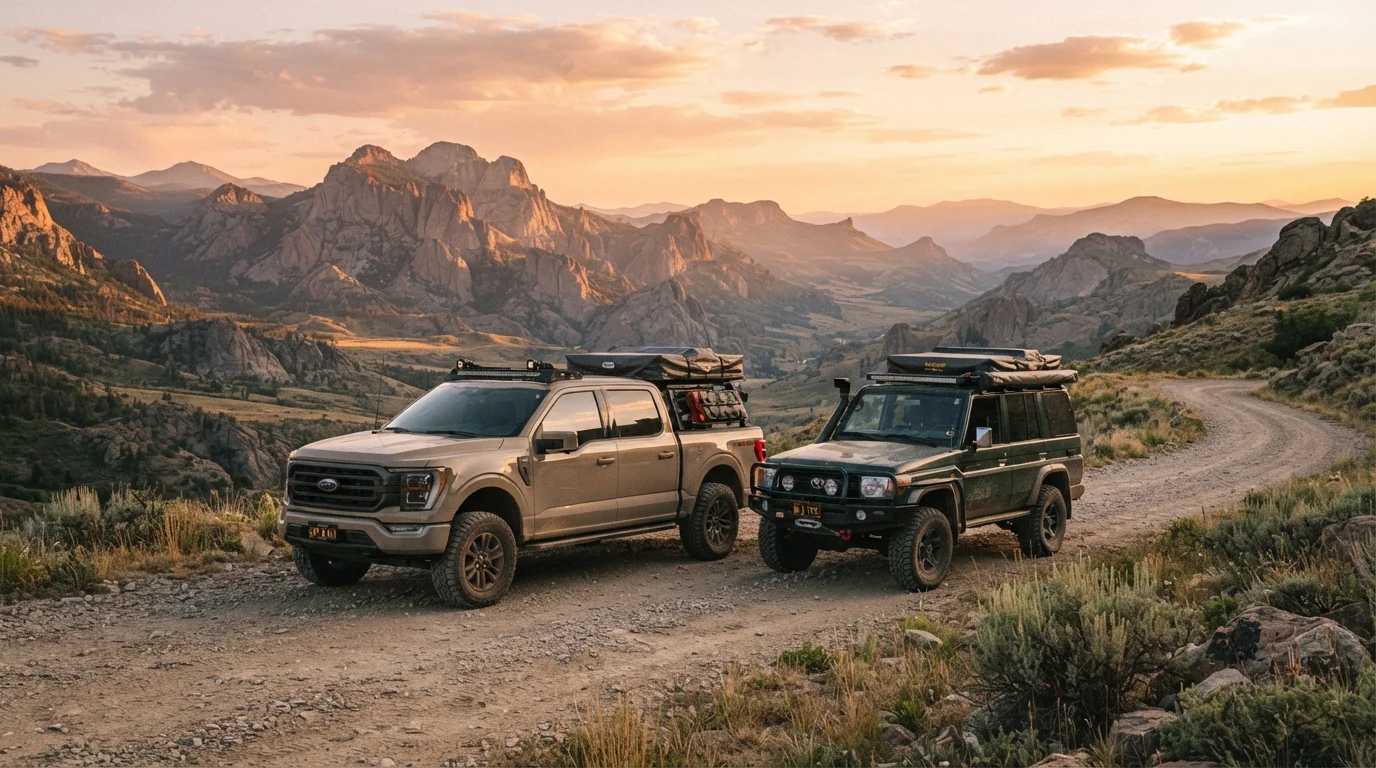
- Off-road and overland use: Ground clearance, approach and departure angles, and suspension articulation define genuine off-road performance - not aesthetic cladding. Our companion piece on the variables that shape off-road capability breaks these factors down in detail.
Rank these by frequency, not intensity. The vehicle that handles your daily reality well is almost always the better ownership decision than one optimized for rare edge cases.
When evaluating tow ratings, find the configuration-specific number in the manufacturer's towing guide - not the headline figure in the brochure. Cab style, bed length, axle ratio, and trailer package all change the number.
Buyers who act on headline tow ratings frequently discover their actual configuration rates 500-1,500 lbs lower, which can disqualify the intended trailer before they've driven it off the lot.
Drive your top candidates in the conditions you actually face - urban traffic, highway merges, parking structures - not just open lots. A vehicle's livability in daily use often reveals trade-offs no spec sheet captures.
Ride quality, turning radius, and visibility vary substantially between a long-wheelbase truck and a unibody crossover, and those differences compound over daily miles in ways that affect long-term satisfaction.
Payload, Towing, and the Numbers That Actually Matter
Tow ratings are among the most misread figures in automotive marketing. A headline tow rating typically reflects a best-case configuration - specific cab, bed length, powertrain, axle ratio, and trailer package. The rating on a fully optioned crew-cab long-bed truck with a heavy aftermarket bed liner and filled passenger seats can be meaningfully lower.
Always Verify the Door-Jamb Payload Sticker
The yellow payload sticker inside the driver's door jamb lists the maximum weight your specific vehicle can carry - passengers, cargo, and trailer tongue weight combined. Advertised tow ratings reflect ideal configurations that may not match the truck in front of you. Exceeding the stated payload capacity affects braking performance, suspension integrity, and tire load ratings, with direct safety implications.
Payload capacity - the combined weight of passengers, cargo, and any tongue weight from a trailer - is printed on the yellow sticker inside the driver's door jamb. This figure, not the advertised number, is legally and mechanically what your specific truck can carry. Exceeding it affects braking distances, suspension wear, and tire loading in ways that create genuine safety risk.
SUVs tow less than comparable trucks on average, but many mid-size and full-size SUVs are rated for 7,500-8,500 lbs - sufficient for boats, campers, and horse trailers that fall within that range. If you're evaluating RV compatibility, the RV class selection checklist provides a useful parallel framework for matching tow vehicle to trailer type.
~15-20%
Typical payload rating gap between trim configurations
Manufacturer towing guides show that cab, bed, and package choices within the same model line commonly shift payload capacity by this margin.
3-5 mpg
Average combined fuel economy difference: truck vs. midsize crossover
EPA combined estimates consistently show this gap between comparable full-size trucks and midsize crossover SUVs across multiple model years.
Drivetrain and Off-Road Capability
Four-wheel drive (4WD) and all-wheel drive (AWD) are often treated as equivalent, but they describe different engineering approaches with different capability profiles. Traditional 4WD systems - common in body-on-frame trucks and SUVs - use a transfer case to lock front and rear axles together, providing maximum traction in low-traction environments but requiring disengagement on dry pavement to avoid drivetrain binding. AWD systems, typical of crossover SUVs, distribute torque continuously and automatically, optimizing for stability on wet or lightly compromised surfaces rather than for sustained technical off-road use.
Neither is universally superior. AWD excels in everyday mixed conditions - rain, light snow, unpaved roads. Part-time 4WD with a low-range transfer case provides the torque multiplication needed for rock crawling, steep grades, and deep mud. For a deeper look at how each layout affects handling and maintenance, see our piece on understanding your vehicle's drivetrain layout.
Total Cost of Ownership Beyond the Sticker
Purchase price is the most visible cost but rarely the most consequential over a five-year ownership window. A full-size truck or body-on-frame SUV typically carries higher operating costs across several categories:
- Fuel: Larger displacement engines and higher curb weights translate to lower EPA combined estimates. The gap between a truck and a midsize crossover can represent meaningful annual cost at typical mileage.
- Insurance: Rates vary by vehicle class, trim level, and repair cost profile. Body-on-frame vehicles with steel ladder frames can have lower structural repair costs in certain collision types; high-trim SUVs with complex driver-assist hardware can be disproportionately expensive to repair.
- Tires: Load-range tires sized for trucks wear at different rates and cost more to replace than standard passenger tires. Tire choices also interact with fuel economy.
- Depreciation: Depreciation patterns vary by segment, trim, and regional market demand. Historically, full-size trucks have held value well in the U.S. market - but this is not guaranteed and varies by configuration.
Accessories and Aftermarket Parts Affect Ratings
Bed liners, running boards, roof racks, and heavy aftermarket bumpers add to curb weight and directly reduce effective payload capacity. Any weight added to the vehicle counts against the payload figure on the door sticker. Factor this in before purchasing accessories for a truck or SUV already operating near its rated limit.
Accessories compound these costs. Some genuinely extend utility; others are cosmetic. For a calibrated look at which SUV add-ons deliver measurable impact, see SUV accessories that actually change daily driving.
Passenger Utility, Cargo Flexibility, and Daily Livability
Body-on-frame SUVs offer genuine eight-passenger capacity with a fully flat load floor when the third row folds - a functional advantage over most trucks. Pickups compensate with an open bed that accepts irregular-shaped cargo, palletized loads, and equipment a closed cargo area cannot accommodate. The bed is also accessible without lifting heavy items over a cargo lip.
Crossover SUVs - despite lower tow ratings - often deliver more usable daily cargo volume and better interior ergonomics than either trucks or body-on-frame SUVs. If third-row seating and all-weather versatility matter more than towing, a crossover often outperforms on the metrics that affect daily experience.
Cab and bed configurations in trucks create meaningful trade-offs: a crew cab with a 5.5-foot bed provides seating for five but limits bed utility; a regular cab with a 8-foot bed maximizes cargo length but loses rear passenger space entirely. These are not interchangeable decisions.
Building Your Decision Framework
A practical decision framework flows from use-case frequency to minimum capability thresholds, then filters on cost of ownership and daily livability. Work through these questions in sequence:
- What is my most frequent use case, and what does it actually require? Separate this from aspirational scenarios.
- Do I have a specific tow or payload need? If yes, identify the minimum rating required for your actual load, then verify it against the window sticker of specific configurations - not trim-level marketing.
- What drivetrain genuinely matches my terrain? AWD for year-round mixed conditions; part-time 4WD with low range for sustained technical off-road use.
- What is my realistic five-year cost of ownership? Factor fuel, tires, insurance, and expected depreciation, not just MSRP.
- What compromises am I making on daily livability? Parking, ride quality, interior ergonomics, and visibility all affect ownership satisfaction.
No single vehicle type dominates every category. The framework above is designed to surface which trade-offs you're actually making - so the choice is deliberate rather than marketing-driven. For long-haul travel planning that intersects with towing decisions, the RV living and setup hub provides additional context on extended-use scenarios.
This article provides general educational information about vehicle categories and should not be taken as personalized financial or purchase advice. Consult qualified professionals for decisions specific to your circumstances.