What a Drivetrain Actually Does
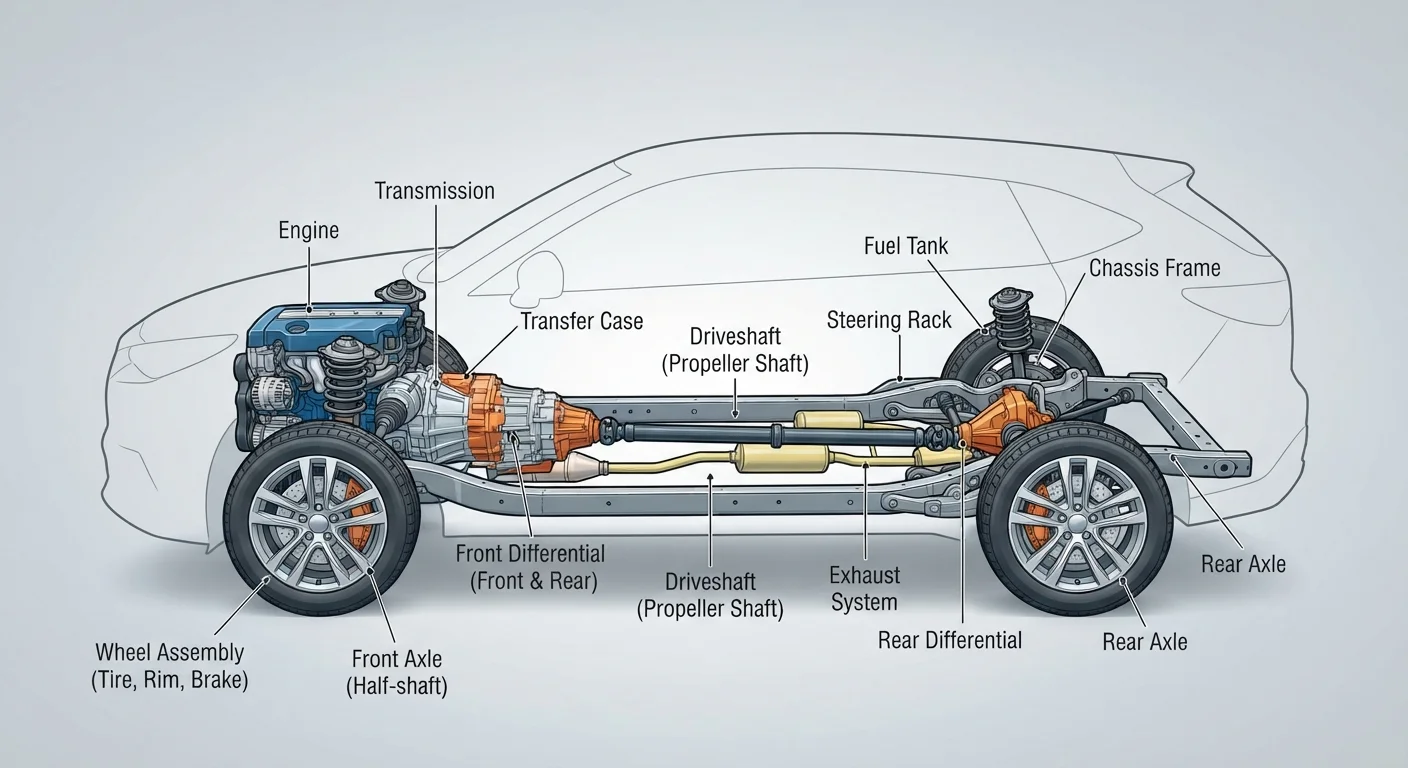
Your vehicle's engine generates power, but that power means nothing until it reaches the wheels. The drivetrain - sometimes called the powertrain's mechanical delivery system - is the collection of components that transfers torque from the engine and transmission out to the driven wheels.
Core drivetrain components include the transmission, driveshaft (where applicable), differentials, axle shafts, and CV (constant velocity) joints or U-joints. Together, these parts convert rotational engine output into the wheel speed and torque that actually move the vehicle.
Drivetrain
The system of mechanical components - including the transmission, driveshaft, differentials, and axles - that transfers engine power to the driven wheels.
Differential
A gear assembly that allows two wheels on the same axle to rotate at different speeds, which is necessary when cornering.
Transfer case
A secondary gearbox found in 4WD and some AWD vehicles that splits power between the front and rear axles and often provides a low-range gear ratio for off-road use.
CV joint
A constant velocity joint that transmits torque from the drivetrain to the wheels at a consistent speed, even as the suspension moves and the wheels steer.
Torque steer
A tendency for FWD vehicles to pull to one side under hard acceleration, caused by unequal forces on the front axle shafts.
Transaxle
A combined unit that integrates the transmission and differential into a single housing, commonly found in front-wheel-drive vehicles.
The layout of a drivetrain - meaning which axle or axles receive power - shapes everything from how the vehicle handles a corner to where you'll focus during routine maintenance.
The Four Main Drivetrain Layouts
Nearly every consumer vehicle uses one of four drivetrain configurations:
- Front-Wheel Drive (FWD)
- Engine power is delivered exclusively to the front axle. The front wheels handle both steering and propulsion. This layout is compact, lightweight, and cost-effective, which is why it dominates the passenger car and crossover segment.
- Rear-Wheel Drive (RWD)
- Power goes to the rear axle only. The front wheels steer while the rear wheels push the vehicle forward. RWD is common on trucks, performance cars, and larger body-on-frame SUVs.
- All-Wheel Drive (AWD)
- Power is distributed to all four wheels, either continuously or automatically when slip is detected. AWD systems vary in sophistication - some bias torque front-to-rear actively, others are reactive. AWD is standard on many crossovers and available on most sedans and wagons.
- Four-Wheel Drive (4WD)
- Like AWD in that all four wheels receive power, but 4WD typically uses a transfer case with selectable high and low range gearing. It is designed for serious off-road or very low-traction use. For a closer look at how trucks and SUVs leverage this, see the variables that shape off-road capability.
Check Your Owner's Manual for 4WD Limits
Part-time 4WD systems are designed for low-traction surfaces - not dry pavement. Driving in 4WD on a high-traction surface can cause drivetrain binding and accelerate wear on the transfer case and axle components. Always confirm the appropriate engagement conditions in your vehicle's owner's manual.
How Layout Affects Handling and Traction
Drivetrain layout has a direct effect on a vehicle's handling balance. With FWD, the front axle carries the combined load of steering, braking, and power delivery - this can limit high-performance handling but generally makes the vehicle predictable and forgiving in everyday conditions. Under hard acceleration, FWD vehicles can exhibit torque steer, a pull to one side caused by unequal axle shaft lengths.
RWD separates the tasks: the front wheels steer, the rear wheels drive. This balance tends to produce more neutral handling at the limit, which is why performance and sports vehicles often favor it. The tradeoff is reduced straight-line traction on slippery surfaces.
AWD improves traction at launch and in low-grip conditions. However, AWD cannot overcome physics in cornering - it doesn't increase the grip available at each individual tire. For a side-by-side comparison in everyday driving scenarios, our article on FWD vs AWD sedans goes into useful depth.
AWD Doesn't Replace Winter Tires
AWD improves traction when accelerating, but it does not meaningfully improve braking or cornering grip on ice and snow - those depend on tire compound and tread design. A FWD vehicle fitted with dedicated winter tires typically outperforms an AWD vehicle on all-season tires in severe winter conditions.
Maintenance Considerations by Layout
Understanding your drivetrain layout helps you stay on top of the right service items:
- FWD: Focus on CV axle boots and joints, which are prone to wear. Inspect boots for cracking or grease loss at each tire rotation. The transmission also contains the differential in a combined unit called a transaxle - use the fluid type and interval specified in your owner's manual.
- RWD: Adds a rear differential with its own gear oil, a driveshaft with U-joints, and rear axle seals. Differential fluid typically requires service every 30,000-60,000 miles depending on use, though always defer to OEM specifications.
- AWD: All the above, plus a center differential or transfer case, additional fluid reservoirs, and - on electronically controlled systems - clutch packs that wear over time. Using mismatched tire sizes or significantly different tread depths can stress AWD components.
- 4WD: Transfer case fluid service is essential and often overlooked. Selectable systems also have engagement mechanisms (electronic motors or locking hubs) that merit periodic inspection.
If you're evaluating a used vehicle with any of these layouts, researching its service history for drivetrain-specific items is worthwhile alongside the general inspection.
Choosing the Right Layout for Your Needs
There is no universally superior drivetrain layout - each suits different use cases. For most urban and suburban drivers in mild climates, FWD delivers sufficient capability with lower complexity and better fuel economy. Drivers in regions with sustained winter conditions or those who regularly tow may find AWD or 4WD worth the added weight and maintenance overhead.
Truck and SUV buyers prioritizing utility should think carefully about how often they'll actually need low-range 4WD versus the convenience of an AWD crossover. Our broader guide to truck and SUV ownership for utility offers a useful framework for mapping real-world use cases to the right platform.
For those exploring the 4WD vs AWD distinction in SUVs in more detail, understanding the mechanical differences outlined here is the right starting point. Matching drivetrain layout to your actual driving conditions - rather than perceived capability - leads to more satisfaction and fewer unnecessary maintenance costs over time.
FWD vs AWD Sedans: When the Difference Matters
A practical comparison of front-wheel and all-wheel drive in everyday sedan driving, helping you understand when AWD genuinely changes the experience.
Off-Road Capability Variables in Trucks and SUVs
Covers ground clearance, locking differentials, approach angles, and suspension travel - the factors that determine genuine off-road performance beyond drivetrain layout alone.