The Three Ratings on Your Door Jamb
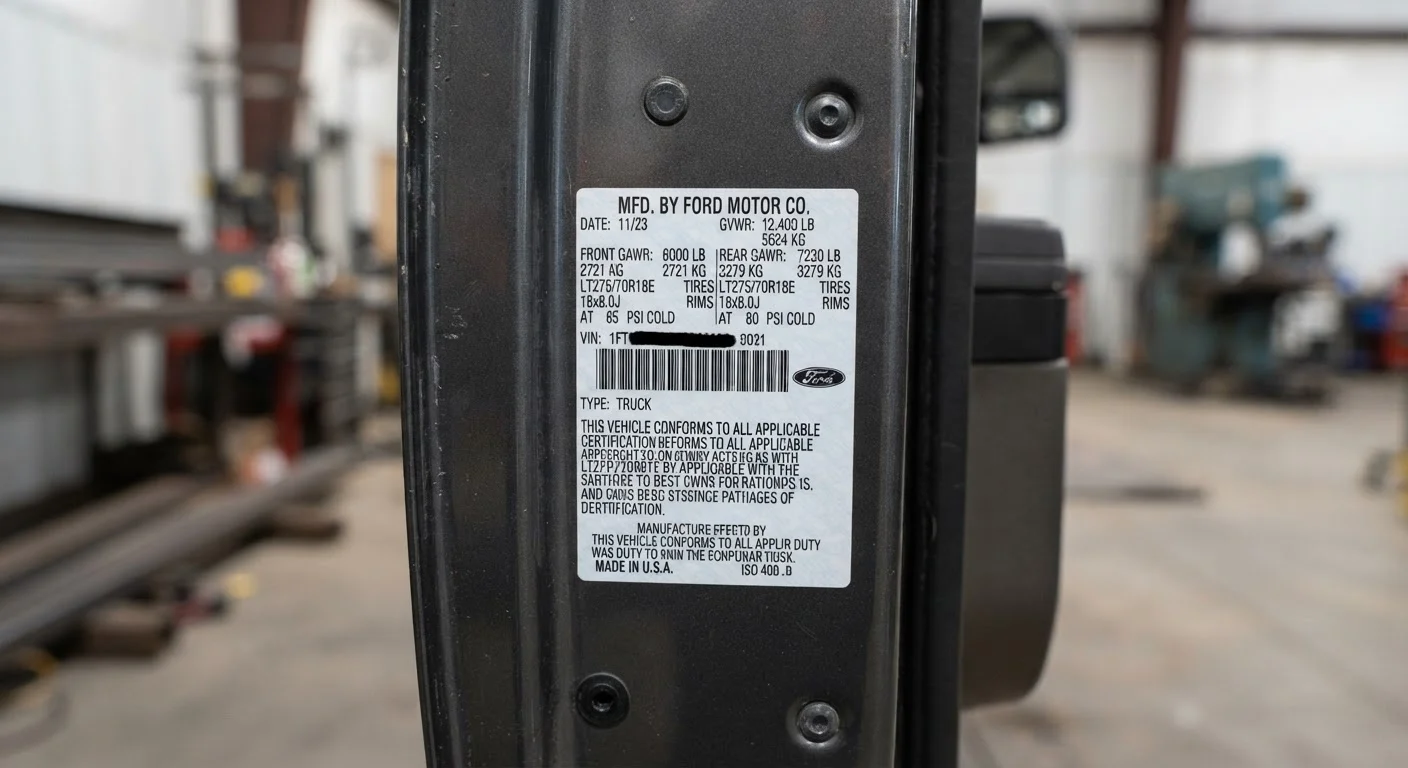
Open the driver's door on any pickup truck or body-on-frame SUV and you'll find a white sticker. Buried among tire pressure specs and paint codes are three weight ratings that determine what that vehicle can legally and safely carry or tow. Most buyers glance past them. Understanding them takes roughly five minutes and can prevent a brake failure, a blown tire, or a crash.
| Where to find these ratings | Driver-side door jamb certification label (Federal Motor Vehicle Safety Standards (FMVSS) requirement) |
| GVWR covers | Curb weight + passengers + cargo + tongue weight |
| GCWR covers | Loaded tow vehicle weight + loaded trailer weight |
| GAWR applies | Separately to front axle and rear axle |
| Typical tongue weight allowance | 10-15% of trailer's gross weight (General industry guideline; verify with vehicle documentation) |
| Legal consequence of overloading | Fines, failed roadside inspections, voided warranty claims |
GVWR - The Vehicle's Total Weight Limit
Gross Vehicle Weight Rating (GVWR) is the maximum the vehicle itself is rated to weigh when fully loaded. That includes the truck's own curb weight, every passenger aboard, all cargo in the bed or cabin, and the tongue weight transferred from any trailer attached to the hitch. The moment you exceed GVWR, you've moved outside what the brakes, suspension, frame, and tires were designed to manage.
Payload capacity - the number buyers care most about - is simply GVWR minus curb weight. Because curb weight varies by cab configuration, drivetrain, and installed options, payload capacity is not fixed across a trim line. Check the door jamb sticker of the specific vehicle, not a brochure figure. For a deeper look at how payload and towing relate to each other, see how payload and towing capacity are measured.
GCWR - The Limit for the Whole Rig
Gross Combined Weight Rating (GCWR) governs towing situations. It sets the ceiling for the combined weight of a fully loaded tow vehicle plus a fully loaded trailer. A truck might have a 10,000 lb towing capacity on paper, but if its GVWR is already nearly consumed by passengers and cargo, GCWR may be the binding constraint. Both limits apply simultaneously - whichever is reached first is the controlling limit.
GAWR - Each Axle Has Its Own Limit
Gross Axle Weight Rating (GAWR) appears twice on the label: once for the front axle (GAWR-FR) and once for the rear (GAWR-RR). Even if the vehicle's total weight stays under GVWR, an uneven load can push one axle past its individual rating. A heavy gooseneck load, for instance, concentrates weight over the rear axle. Overloading a single axle stresses its bearings, half-shafts, and the tires mounted to it - all independently of the vehicle's gross weight.
GVWR
Gross Vehicle Weight Rating - the maximum total weight a vehicle is engineered to carry, including its own curb weight plus passengers, cargo, and any tongue weight from a trailer. Exceeding it invalidates the vehicle's designed safety envelope.
GCWR
Gross Combined Weight Rating - the maximum allowable weight of the fully loaded tow vehicle plus the fully loaded trailer together. This figure governs the powertrain and chassis under towing conditions.
GAWR
Gross Axle Weight Rating - the maximum load each individual axle is certified to bear. A vehicle has separate front (GAWR-FR) and rear (GAWR-RR) ratings, and each must be respected independently.
Curb Weight
The weight of an unloaded vehicle with a full tank of fuel but no passengers or cargo. Subtract curb weight from GVWR to find the vehicle's payload capacity.
Tongue Weight
The downward force a trailer's hitch coupler exerts on the tow vehicle's hitch ball. It counts against the tow vehicle's payload and GVWR, and must stay within the hitch's rated tongue weight limit.
Payload Capacity
The maximum combined weight of passengers, cargo, and tongue weight a vehicle can carry. It is derived from GVWR minus curb weight, and it varies by configuration - not just by trim level.
Why Exceeding These Ratings Is Genuinely Dangerous
These Ratings Are Engineering Limits, Not Recommendations
GVWR, GCWR, and GAWR are the maximum values a vehicle's structure, brakes, tires, and axles were designed and tested to handle - not comfortable targets to approach routinely. Real-world conditions such as heat, altitude, worn components, or uneven load distribution reduce the effective margin further. Treat these numbers as hard ceilings, not goals.
Weight ratings aren't arbitrary bureaucratic figures. They emerge from engineering analysis and physical testing of every load-bearing system in the vehicle: the frame's flex tolerances, brake bias calibration, tire load indexes, axle bearing ratings, and hitch receiver welds. Exceed any one ceiling and the margin of safety that those systems rely on shrinks - or disappears entirely.
Braking Distance Grows Non-Linearly
Brake systems on light trucks are calibrated for the vehicle's rated maximum weight. An overloaded truck doesn't just stop a little slower - stopping distance increases disproportionately as weight climbs. At highway speeds, even modest overloading can add dozens of feet to stopping distance, a difference that can determine whether a collision occurs.
Tire Failure Risk Increases
Every tire carries a load index rating. If total axle weight pushes individual tire loads past their index, heat builds inside the carcass faster than it can dissipate. The result can be a tread separation or blowout - a particularly serious event when towing at speed.
Structural and Legal Consequences
Frame fatigue accumulates with repeated overloading, and manufacturers' warranty coverage for structural damage typically does not apply when the vehicle was operated outside its rated limits. On the road, commercial and roadside weight enforcement can result in fines and required off-loading. Insurance claims arising from accidents while overloaded can also face scrutiny.
Before finalizing any hauling plan, cross-reference the towing chart for your specific configuration. Reading manufacturer towing charts without being misled explains how to navigate footnotes and configuration-specific asterisks that quietly change the headline number. And keep in mind that ratings can shift between model years - comparing trucks across model years covers the errors buyers make when relying on older specs.
If you're evaluating a trailer or RV alongside a tow vehicle, the same weight terminology applies on the trailer side. The RV glossary covers GVWR, dry weight, and related terms as they appear in RV specifications.
3
Distinct weight ratings on every truck door jamb
GVWR, GAWR-FR, and GAWR-RR are federally mandated on all light-duty and medium-duty trucks sold in the US.
10-15%
Recommended tongue weight as share of trailer weight
The general industry guideline; exceeding this range can cause trailer sway and destabilize the tow vehicle.