What Each Approach Actually Means
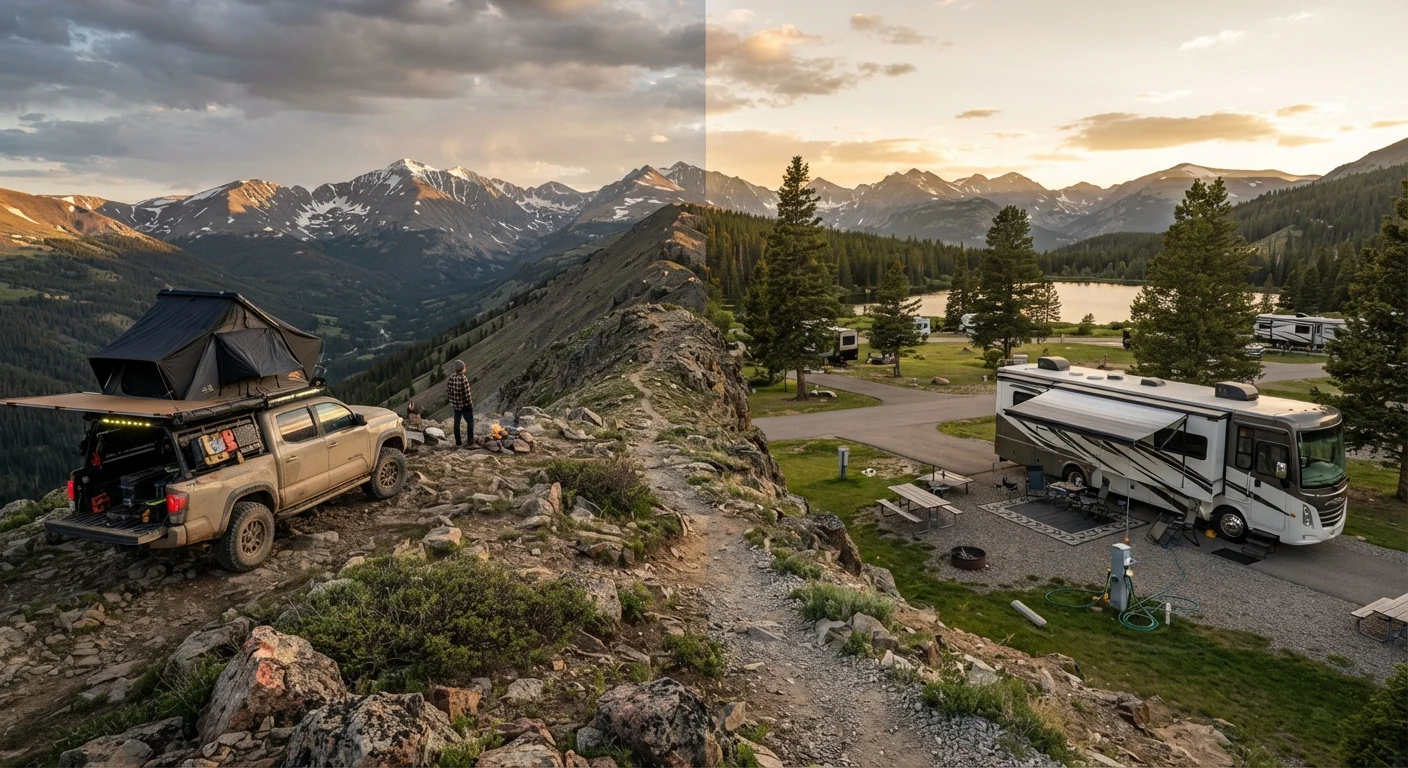
Overlanding and RV camping are both forms of vehicle-based travel, but they start from opposite assumptions about what matters most. Overlanding - broadly defined as self-reliant, vehicle-supported travel over remote or off-road terrain - treats the journey and the terrain as the destination. The rig is typically a capable 4x4 truck or SUV outfitted with recovery equipment, auxiliary power, water storage, and sleeping solutions like a rooftop tent or ground tent. Comfort is functional, not luxurious.
RV camping, by contrast, is built around a rolling living space. Whether it's a Class A motorhome, a fifth wheel, or a truck camper, the RV format assumes access to established roads and often to campground hookups for water, electricity, and sewer. The priority is livability over terrain access. For a deeper look at how RV formats differ from each other, comparing motorhomes to towable RVs is a useful starting point.
| Criterion | Overlanding | RV Camping |
|---|---|---|
| Terrain access | Technical off-road capable | Paved and improved roads |
| Sleeping setup | Rooftop tent or ground tent | Fixed bed, often multiple |
| Kitchen facilities | Portable camp stove | Full kitchen with refrigerator |
| Bathroom access | Camp or portable solutions | Onboard bathroom standard |
| Power supply | Auxiliary battery, solar | Shore power, generator, solar |
| Group size suitability | Solo to small group | Family to large group |
| Nightly site cost | Often free (dispersed camping) | Developed site fees typical |
| Vehicle fuel efficiency | Lower (4x4 trucks/SUVs) | Lower (large RVs) |
| Setup and teardown time | Moderate (camp systems) | Quick at hookup sites |
Capability, Terrain, and Where You Can Actually Go
The most fundamental difference between these two setups is terrain access. A purpose-built overland rig with proper ground clearance, locking differentials, and all-terrain tires can navigate forest service roads, washed-out two-tracks, and rocky mountain passes that would strand any standard RV. Purpose-built off-road engineering takes this even further, but a well-equipped production truck can cover most overland routes.
RVs, even Class B campervans - which are the most maneuverable format - are constrained by their wheelbase, height, and weight. Unpaved roads are possible with care, but technical off-road travel is not. This isn't a flaw; it's a design priority. RVs are optimized for paved and improved surfaces, where they deliver comfort that no overland rig can match. The right RV class for your trip type depends heavily on how and where you plan to travel.
640M+
Acres of U.S. public land open to dispersed camping
The Bureau of Land Management oversees roughly 245 million acres; combined with U.S. Forest Service lands, dispersed camping access is substantial for overland travelers.
~11,000 lbs
Typical gross vehicle weight of a Class C motorhome
This weight constrains which roads and bridges a motorhome can safely navigate, a key factor when planning routes on less-maintained roads.
10-15 MPG
Typical fuel economy range for large RV formats
Motorhomes and fifth-wheel tow vehicles generally return 10-15 MPG; overland trucks similarly range from 14-18 MPG depending on load and terrain.
Living Space, Comfort, and Amenities
An overland setup typically means sleeping in a rooftop tent or ground setup, cooking on a single-burner camp stove or portable propane system, and managing water from jerry cans or an onboard tank measured in gallons rather than dozens. Hygiene solutions range from camp showers to gym memberships near trail towns. This is manageable - many long-term overlanders adapt quickly - but it requires genuine willingness to live simply.
RVs invert this entirely. Even a modest travel trailer offers a dedicated bed, a real kitchen with a refrigerator and stovetop, and an onboard bathroom. Larger motorhomes include slide-outs that expand interior space substantially. Power management is its own discipline - shore power, solar, and generators each carry different constraints - but the fundamental amenity level is far above any overland rig. For families or anyone traveling for more than a few weeks, that gap is hard to close with gear alone.
Accessories Overlap More Than You'd Expect
Some gear serves both worlds well. Portable power stations, water filtration systems, and roof-mounted storage solutions appear in both overland and RV builds. Navigation tools matter in either case - offline maps and GPS device options are worth reviewing before any remote trip. The ecosystems diverge sharply on living space and terrain capability, but the accessories layer has genuine crossover.
Costs, Ongoing Expenses, and Honest Trade-Offs
Neither setup is cheap, but the cost structure differs significantly. An overland build begins with a capable base vehicle - typically a mid-size or full-size truck or body-on-frame SUV - and layers on suspension upgrades, recovery equipment, auxiliary power, and sleeping solutions. Entry-level builds are possible for modest sums; serious expedition-level rigs can cost substantially more. Running costs include fuel (4x4 trucks are rarely efficient), maintenance, and tires that wear faster on mixed terrain.
RV ownership carries purchase cost, insurance, storage, site fees, and maintenance on a complex system of appliances and plumbing. Campground fees at developed sites with full hookups add up quickly over a season. Dispersed camping and boondocking - camping off-grid on public land - can offset this, but most RV owners still rely heavily on developed infrastructure. If full-time living is the end goal, the practical considerations of full-time RV life go well beyond the purchase decision. For those comparing RV formats before committing, motorhome versus fifth wheel for full-time living covers the key trade-offs in detail.