Why Most Packing Advice Gets It Wrong
The majority of road-trip packing lists fall into one of two traps: they're either so exhaustive they turn your car into a rolling warehouse, or they're so stripped-down they leave you stranded without a working phone charger 200 miles from the nearest town. Neither extreme serves you well.
The honest framework is simpler: categorize every item by what happens if you don't have it. Items that could create a safety risk if absent are non-negotiable. Items that affect comfort or convenience are worth weighing against available space. Everything else is probably unnecessary baggage.
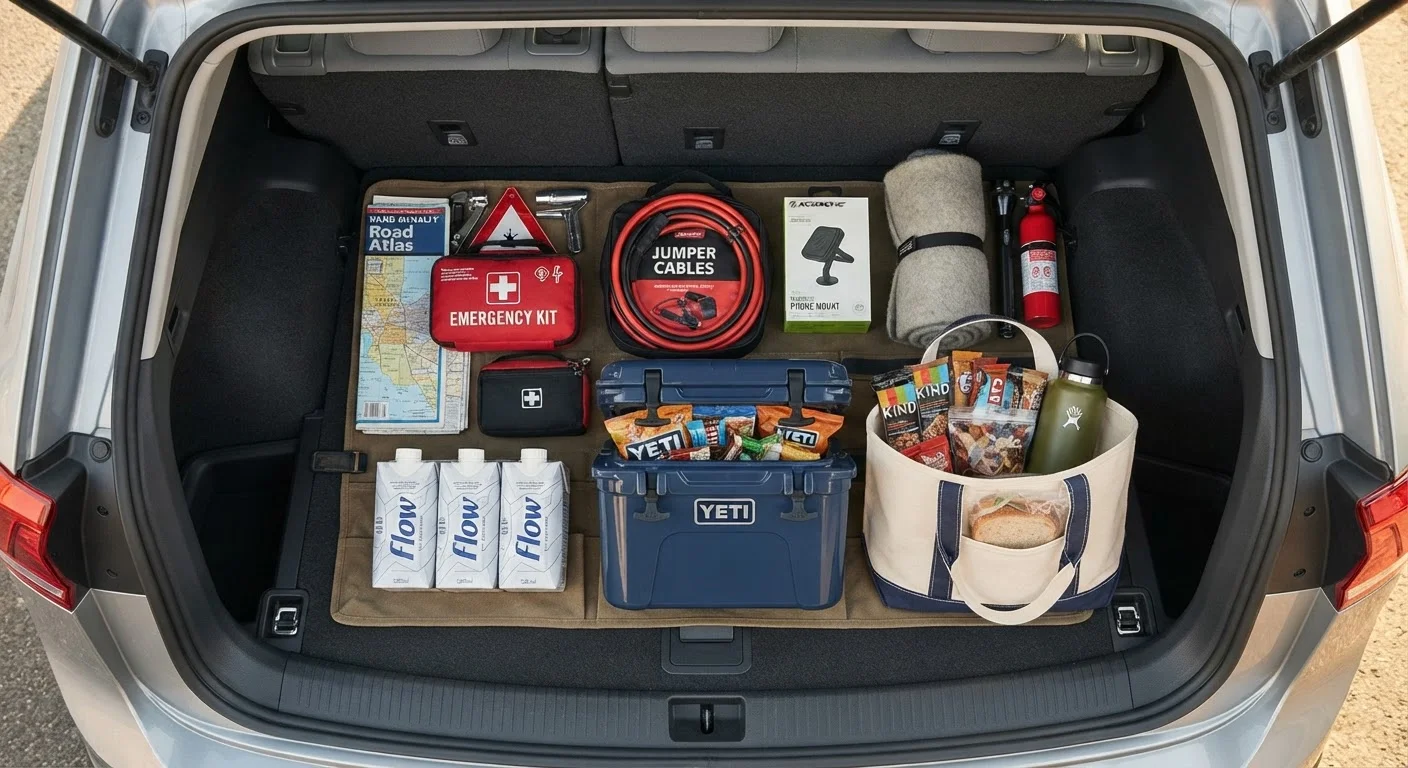
Gear that earns its place is also gear that fits without compromising your load. Poor weight distribution and overstuffed trunks affect braking distances and handling in ways many drivers don't anticipate - see our common boot-packing mistakes for a breakdown of the loading errors that most often catch drivers off guard.
Use the checklist below as an audit tool, not a shopping list. Work through each category against what you already own before considering anything new.
Offline Navigation App
Provides turn-by-turn directions without cellular connectivity - essential in rural or low-signal areas.
Portable Jump-Start Pack
Lets you restart a dead battery without needing another vehicle or waiting for roadside assistance.
Vehicle First-Aid Kit
Covers minor injuries during the trip; vehicle-specific kits typically include bandages, antiseptic, and a CPR face shield.
Portable Battery Bank
Keeps phones and navigation devices charged across long stretches without access to charging infrastructure.
Reflective Warning Triangle or Road Flares
Alerts oncoming traffic to a stopped vehicle - required by law in some states and strongly advised everywhere.
Tire Pressure Gauge
Allows quick checks at fuel stops; maintaining correct tire pressure affects fuel efficiency, handling, and tire longevity.
Dash Cam
Records forward-facing video that may be useful in insurance or incident disputes; coverage limitations vary by model.
The Road Trip Packing Checklist
The groups below are organized by function. Work through them in order - safety first, navigation second, mechanical support third, then comfort and convenience. Items marked must are genuinely non-negotiable for any trip over 50 miles. Items marked should are strongly worth including if space allows. Nice-to-have items earn their place only once the essentials are covered.
Safety & Emergency Essentials
Navigation & Communication
Mechanical & Roadside Support
Comfort & Convenience
Trunk Load Affects Vehicle Safety
Heavy or unevenly distributed cargo raises a vehicle's center of gravity and can meaningfully affect braking distance and handling - especially in emergency maneuvers. Keep the heaviest items low and centered, and never exceed your vehicle's stated payload capacity. If you're unsure of your vehicle's limits, check the placard inside the driver's door jamb or your owner's manual.
If you're travelling with passengers and want to address comfort in more depth - lumbar support, window shading, rear-seat organization - our companion piece on keeping passengers comfortable on multi-day drives covers the cabin side of the equation. First-time solo drivers should also review solo road trip gear and safety fundamentals before heading out alone.
Seasonal and Trip-Specific Adjustments
This checklist reflects a baseline applicable to most US driving conditions. Your actual kit should shift based on season, terrain, and trip duration. Winter driving in the Mountain West demands traction aids, an ice scraper, and a heavier emergency blanket than a summer drive along the Gulf Coast ever would. Conversely, extreme summer heat calls for added water capacity, sunshade coverage, and attention to coolant levels before departure.
Don't Rely on a Single Power Source
If your navigation, music, and communications all run through one phone plugged into the car's USB port, a blown fuse or failed charging cable can cut off all three simultaneously. Carry a charged external battery pack as a fallback, and download offline maps before you leave so they don't require active data to function.
For a detailed seasonal breakdown, see road trip gear across seasons, which walks through what to add, swap, or remove from your kit as conditions change.
Travelling with a pet changes the equation further - carriers, restraints, and water access all become priority items. Our guide on pet-friendly road trip safety covers that ground specifically. And if you're wondering how much of this a roadside assistance plan would cover in a breakdown scenario, what roadside assistance actually covers offers an honest look at the gaps.
Finally, don't overlook fatigue management as part of your preparation. The gear you carry to stay alert - and the habits that support it - are as important as any physical item in the trunk. Our article on managing driver fatigue on long hauls covers evidence-backed approaches worth reading before a big trip.