
Why Lenders Think in Tiers, Not Points
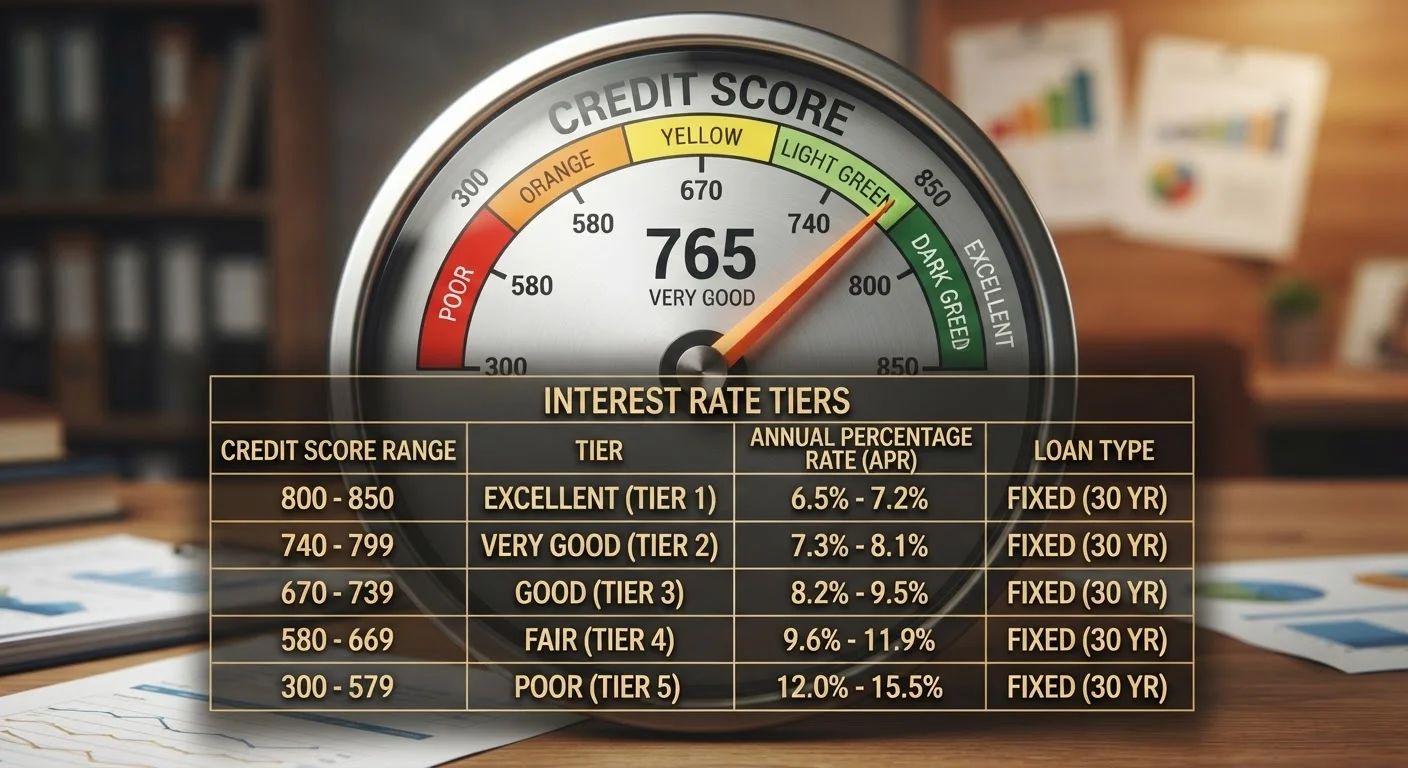
When a lender evaluates your auto loan application, it does not set a unique interest rate for every possible credit score. Instead, it maps scores onto a small set of risk tiers - each tier carrying a pre-set rate range. A borrower with a 695 score and one with a 715 score might land in the same tier and receive an identical rate offer, while someone at 720 could step into a higher tier and access a noticeably lower APR.
This approach exists because pricing risk at the individual score level is operationally impractical and statistically unreliable at fine margins. Tier-based pricing lets lenders maintain consistent underwriting standards and manage portfolio risk across thousands of loans simultaneously. For borrowers, the implication is important: a modest score improvement that does not cross a tier boundary may produce no rate benefit at all, whereas a small gain that does cross a boundary can produce a substantial one.
To understand how lenders read your full credit report, it helps to recognize that tiers are just one lens - payment history, account age, and utilization all feed into the score that determines your tier placement.
Typical Tier Structures and Their Rate Implications
While tier definitions vary by lender, industry practice generally follows a pattern built on five broad categories:
- Super prime (approximately 720 and above): Borrowers in this band typically access the lowest advertised rates. Lenders view this group as having the strongest repayment history and lowest default probability.
- Prime (approximately 660-719): Rates in this tier are competitive but meaningfully higher than super prime. This is a large segment of the market.
- Near prime (approximately 620-659): Rates climb more sharply here. Lenders price in elevated risk, and some may require larger down payments.
- Subprime (approximately 580-619): Rates increase substantially. Loan terms, vehicle age restrictions, and down payment requirements often become more restrictive.
- Deep subprime (below 580): Financing may be available through specialty lenders at high APRs, or may require a co-signer.
~5-6 pts
Typical APR gap between prime and subprime auto loans
Industry data from sources such as Experian's State of the Automotive Finance Market reports consistently show a multi-percentage-point spread between tier categories for both new and used vehicles.
$2,000+
Potential total interest difference across one tier change
On a $30,000, 60-month loan, a 3-percentage-point APR difference - a typical gap between adjacent tiers - can exceed $2,000 in additional interest over the loan life.
14-45 days
Rate-shopping window treated as a single credit inquiry
FICO scoring models consolidate multiple auto loan inquiries made within this window, allowing borrowers to compare lender offers without compounding credit score impact.
For context on how these tiers map to broader score definitions, the article credit score ranges and what they mean for your car loan rate provides a detailed breakdown. Note that most lenders use a FICO Auto Score variant, which may weight certain behaviors - like prior auto loan repayment history - differently than a generic credit score.
What Else Moves Your Rate Within a Tier
Credit tier placement establishes a rate range, not a fixed number. Lenders then refine the final APR offer based on several additional variables. Understanding these factors helps you spot where a quoted rate is positioned within a tier's band - and whether there is room to negotiate.
Check Your Score Before You Apply
Pulling your own credit report is a soft inquiry and does not affect your score. Reviewing it before applying lets you identify your likely tier placement and spot any errors that could be suppressing your score. Correcting a reporting error - even a small one - could be enough to push you into a higher tier.
Loan-to-value (LTV) ratio: If the amount you're borrowing is close to or exceeds the vehicle's appraised value, lenders often price toward the top of the tier range. A larger down payment reduces LTV and may bring the rate toward the more favorable end. See how LTV affects your rate and approval odds for a full explanation.
Debt-to-income (DTI) ratio: Even within the same credit tier, a borrower carrying heavy existing debt relative to income may receive a less favorable rate. Lenders view high DTI as a cash-flow risk that your score alone doesn't fully capture. The article on debt-to-income ratio and why it matters beyond your credit score explains the mechanics.
Loan term: Longer terms generally carry higher rates. A 72-month or 84-month loan typically costs more per dollar borrowed than a 48-month loan, even for the same borrower in the same tier.
New vs. used: Used vehicle loans are almost universally priced higher than new vehicle loans, reflecting the greater uncertainty in collateral valuation over time.
How to Use Tier Logic When Shopping for a Loan
Knowing that lenders think in tiers gives you a practical framework for evaluating your position before you apply. If your score sits just below a common tier boundary - say, at 655 when a lender's prime cutpoint is 660 - a targeted effort to raise your score by a few points could produce a meaningful rate reduction, not just a cosmetic improvement.
Comparing offers from multiple lenders is equally important because tier boundaries are not standardized. A credit union may define "prime" starting at 650 while a captive automaker lender defines it at 680. The same score can legitimately earn different rates from different institutions. Rate shopping within a compressed window - typically 14 to 45 days depending on the scoring model - is generally treated as a single inquiry, protecting your score while you gather real offers.
Finally, verify whether the rate you're offered is fixed or variable. Most auto loans use fixed rates, but understanding the distinction matters. Fixed-rate vs. variable-rate auto loans affect long-term payment stability in ways that tier placement alone does not determine.
This article is for general informational and educational purposes only and does not constitute personalized financial or lending advice. Consult a qualified financial professional before making decisions based on your specific circumstances.