Why Documents Matter as Much as the Metal
A classic vehicle is always more than its physical components. It is also a story-and in collector markets, that story needs receipts. Provenance documentation provides the evidentiary foundation that separates a credible representation from an optimistic claim. As auction results consistently show, two mechanically identical vehicles from the same model year can carry vastly different hammer prices based solely on what paperwork accompanies them.
This dynamic is not snobbery. It reflects a rational response to information asymmetry: buyers cannot disassemble a car at an auction preview, so documents fill the gap. When factory records confirm that a vehicle left the assembly line with a specific high-performance engine, a rare color combination, or a desirable options package, that confirmation has measurable monetary value. Without it, the buyer is pricing in the possibility that the seller's account is incorrect-or worse, fabricated.
For a deeper look at how these variables compound into final valuations, see what separates a $30,000 classic from a $300,000 one.
20-40%
Typical premium for fully documented examples
Industry appraisers and auction specialists commonly cite a 20-40% value premium for classic vehicles with complete factory documentation versus undocumented equivalents in comparable condition.
~30%
Broadcast sheets that survive to present day
Collector community estimates suggest only a fraction of original broadcast sheets remain with their vehicles, making surviving copies disproportionately influential in pricing.
1 in 5
Auction consignments with complete paper trails
Experienced auction specialists note that fully documented vehicles-factory paperwork through current title-represent a minority of consignments, which is part of why they attract competitive bidding.
The Core Documents Collectors and Appraisers Seek
Broadcast sheets and build sheets are the most sought-after factory documents in American muscle car and pony car collecting. Generated on the production line, these sheets list every option code, color, drivetrain component, and special order instruction for a specific VIN. Because they were working documents rather than customer-facing materials, surviving copies found under carpet or inside door panels carry a high authenticity premium. Cross-referencing a broadcast sheet against the vehicle's trim tag and VIN is a standard verification step.
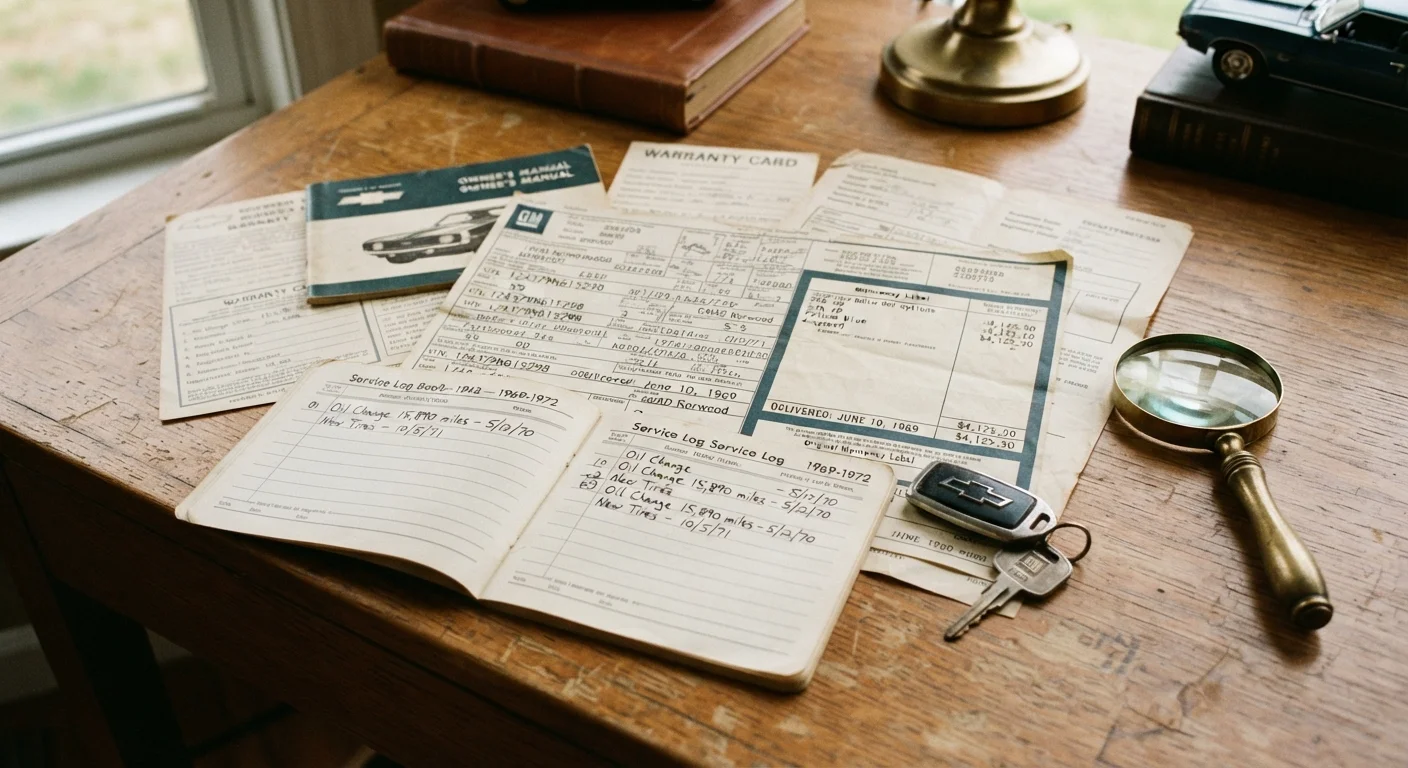
Window stickers (formally Monroney labels, named after the federal legislation requiring them) document the original MSRP, standard equipment, and dealer-installed options. A matching-numbers car with its original window sticker present is considered significantly more desirable at concours events and major auctions. The sticker also records the selling dealer's name and location, which can anchor further ownership research.
Dealer invoices and shipping documents occasionally survive in family-owned vehicles and provide the original transaction price-useful context for understanding what options were genuinely ordered versus later added.
Title history and registration records establish the chain of ownership. Consecutive, coherent titles from the state of original sale forward support mileage claims and help rule out odometer irregularities. A vehicle with a single-family ownership history documented through titles carries a narrative that buyers and appraisers respond to positively.
For guidance on reading modern electronic history reports alongside these physical documents, see reading a vehicle history report without getting lost in the data.
“A car without paperwork is a car you have to take on faith. A car with its original broadcast sheet and window sticker is a car that can defend its own history.”
— Classic & Specialty Vehicles Editorial Team, Automotive historians and collector market analysts
Service Records, Period Photos, and Supporting Evidence
Beyond factory paperwork, the accumulated maintenance record of a vehicle's life provides its own form of provenance. Dated dealership service tickets, independent shop receipts, and parts invoices create a chronological record that supports mileage claims and speaks to how conscientiously the vehicle was maintained. For a car represented as a genuine low-mileage survivor, a stack of period service records is close to irreplaceable.
Period photographs-snapshots showing the vehicle at family events, in a driveway with identifiable context, or at early shows-add a human dimension that documents alone cannot provide. A photograph from the early 1970s showing the car in its current color, with the correct trim, is meaningful corroborating evidence that it has not been substantially altered.
Owner-kept logbooks, though informal, signal the kind of meticulous custodianship that serious collectors value. The habit of building and maintaining such records pays dividends at resale-a principle explored in detail in building a personal maintenance log and why it pays off at resale.
Preserve What You Have-Even Fragments
If you currently own a classic vehicle, photograph and digitally archive every document in your possession, even partial or worn ones. Store originals in archival-quality sleeves away from heat and moisture. A fragment of a broadcast sheet is better than no broadcast sheet, and a complete photographic record of your documentation file is valuable insurance against physical loss.
Gaps, Red Flags, and the Limits of Paper
Documentation can be absent for entirely innocent reasons-house fires, estate dispersals, indifferent prior owners-and absence is not the same as fraud. However, specific patterns deserve scrutiny. A vehicle claimed as a rare, high-value variant but supported only by a single document that cannot be cross-referenced against physical evidence warrants caution. Similarly, documents that do not match-a window sticker listing one engine while the trim tag shows another-raise questions that must be resolved before purchase.
The collector community has documented a persistent problem: provenance claims that sound compelling on paper but collapse under methodical examination. Common failure points include reproduction documents presented as originals, option codes that do not appear on any surviving factory reference, and ownership histories with unexplained geographic gaps. Why provenance claims on specialty vehicles fail under scrutiny addresses these patterns in detail.
Marque clubs and owner registries can be invaluable verification resources. Many maintain chassis records, decode VINs for specific model years, and can cross-reference a claimed configuration against known production data. Collector registries and archives explains how these organizations operate and what they can confirm. Always treat documentation as one input among several-physical inspection of stampings, tags, and component date codes remains essential.
For the full picture of what it means to own and steward a documented classic, see the full spectrum of classic car ownership.
Documentation Standards Vary by Marque and Era
Not all manufacturers produced broadcast sheets, and not all surviving paperwork follows a standardized format. Pre-war vehicles, imported classics, and limited-production specialty vehicles often require different documentation frameworks than domestic postwar muscle cars. Consulting a marque-specific expert or registry is the most reliable way to understand what constitutes complete documentation for a specific vehicle.