Why Terminology Matters in the Collector Market
Walk through any major auction preview or specialist classifieds and you'll encounter the words replica, tribute, and continuation used loosely - sometimes interchangeably, often incorrectly. That imprecision carries real financial risk. The misconceptions that routinely distort the specialty vehicle market often begin exactly here: a buyer assumes one category and purchases another. Understanding the legal, historical, and commercial distinctions between these three vehicle types is foundational to sound collecting.
These aren't merely academic labels. They shape insurance eligibility, title classification, registration requirements, and - critically - what a sophisticated buyer will pay at auction or in a private sale.
Replicas: Imitation With Varying Degrees of Integrity
A replica is a vehicle built to visually reproduce an existing or historical design, typically using a different chassis, drivetrain, or both. Replicas are not the original car; they are approximations. Quality ranges from hand-crafted, engineering-intensive builds that faithfully reproduce period dimensions and materials, to mass-produced kit cars assembled from fiberglass bodies over unrelated donor platforms.
In the United States, replica vehicles are subject to the Low Volume Motor Vehicle Manufacturers Act (signed into law in 2015), which created a federal pathway for small-scale producers to manufacture replicas without meeting all modern safety standards - provided the vehicle is sold as a replica and not represented as original. This legal framework matters enormously: a replica sold with fraudulent title documentation as an authentic original is not a legal gray area; it is fraud.
Misrepresentation Carries Legal Consequences
Selling a replica or tribute as an authentic original - or as a continuation vehicle without valid licensing documentation - can constitute wire fraud or consumer fraud under federal and state law. Buyers who suspect misrepresentation should consult an automotive attorney before completing a transaction. Always obtain a written, specific description of what the vehicle is and what it is not.
From a valuation standpoint, even the finest replicas rarely approach the price of a genuine example. The exception occurs when a replica is so period-correct, so well-documented as a replica, and so crafted by a recognized builder that it develops a collector following entirely on its own merits - independent of the original it echoes. See how originality and documentation compound valuation to understand why provenance gaps carry such a steep discount.
Tribute Vehicles: Honest Homage
A tribute vehicle is distinguished by intent and disclosure. A tribute is typically an authentic example of a related but different model - or a period-correct variant - configured to resemble a rarer, more desirable vehicle. The classic example: a standard Mustang fastback dressed to appear like a Shelby GT350, with the seller openly representing it as a tribute rather than the real thing.
Tributes occupy an interesting market position. Done transparently, they are entirely legitimate. Many enthusiasts actively seek well-built tributes because they offer the visual and driving experience associated with a rare variant at a fraction of the cost. The trouble arises when tributes are misrepresented - when documentation is vague and a buyer assumes more than was offered. Careful review of the Vehicle Identification Number (VIN), build sheet, and any available Marti Reports or factory documentation is essential before any purchase. For guidance on how condition and documentation interact with value, the factory originality vs. restored-to-spec comparison offers relevant context.
Verify Tribute Claims With Factory Records
Before purchasing a tribute vehicle, decode the VIN through the relevant manufacturer's registry or a recognized marque club. Many marques maintain ownership registries that can confirm - or disprove - what a car actually was when it left the factory. Marti Reports (for Ford products) and similar factory data services are invaluable tools for this verification step.
Continuation Vehicles: The Manufacturer's Stamp
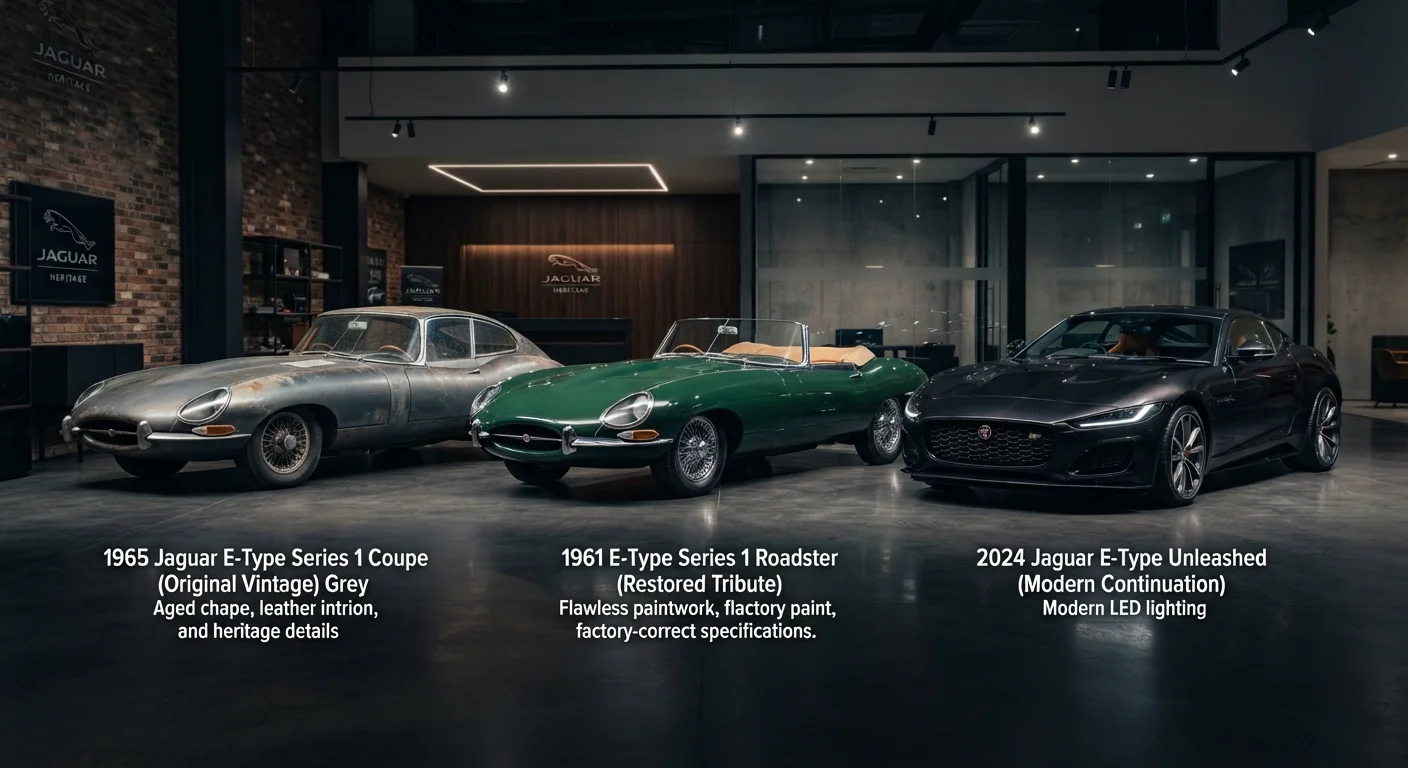
A continuation vehicle occupies a fundamentally different category. These are vehicles produced - or sanctioned for production - by the original manufacturer, a legally licensed successor entity, or a rights holder with demonstrable continuity of ownership. Examples include continuation Cobras produced under Carroll Shelby's authority, or continuation D-Types authorized by Jaguar Classic. The manufacturer's imprimatur is what separates a continuation from a high-quality replica.
Because continuation vehicles carry legitimate factory lineage, they are treated very differently by the collector market. Many are assigned sequential chassis numbers in line with the original production run, and they may be accompanied by factory certification. Insurers with specialist classic vehicle programs often extend coverage terms similar to original examples. Auction results for properly documented continuations frequently approach - and in some cases match - period originals, particularly when supply of genuine examples is severely limited.
| Replica | Tribute | Continuation | |
|---|---|---|---|
| Manufacturer authorization | None | None | Yes - factory or licensed successor |
| Typical title classification | Replica or kit car | Original model (different variant) | Often treated as original |
| Chassis/VIN lineage | Unrelated or new chassis | Original production VIN | Sequential factory numbering common |
| Relative market value | Significant discount to original | Moderate discount; varies by quality | Approaches or matches period original |
| Insurance treatment | Specialty kit car policies | Classic car policies (as base model) | Often same as original examples |
| Collector legitimacy | Accepted if honestly represented | Widely accepted when disclosed | Fully recognized by serious collectors |
| Key documentation | Builder records, state title | Factory build sheet, VIN decode | Factory cert, chassis number registry |
The distinction is not merely commercial sentiment. It reflects verifiable chain of custody, manufacturing authority, and documentation integrity - the same criteria that underpin value judgments across the broader collector market. For a deeper look at how these valuation factors interact, consult our end-to-end restoration and value guide.
Due Diligence Before You Buy
Regardless of category, informed buyers apply the same core verification disciplines. Request all available documentation: title history, build records, previous inspection reports, and any correspondence with the manufacturer or licensing authority. For continuation vehicles specifically, confirm that the issuing entity held valid rights at the time of production - a detail that has occasionally been contested in the market. The value myths that cost collectors dearly often center on assumed documentation that was never verified.
Parts authenticity is a related consideration. Understanding whether components are original, period-correct replacements, or modern equivalents affects both restoration assessments and insurance valuations. The difference between OEM, OES, and aftermarket parts is relevant when evaluating a vehicle's component provenance - especially for continuations where factory-spec parts may have been sourced from third parties.
This article provides general educational information about vehicle classifications and collector market dynamics. It does not constitute legal, financial, or appraisal advice. Consult a qualified appraiser, attorney, or financial adviser for guidance specific to your situation.