Why Documentation Hierarchy Matters
In the collector vehicle market, a seller's verbal account of a car's history is the weakest possible form of evidence. Genuine provenance is established through a hierarchy of primary documents, physical markings, and independently verifiable records - each carrying a different degree of evidentiary weight. Understanding that hierarchy is the first practical skill any serious buyer or consignor needs.
Misrepresented histories are a persistent problem in niche vehicle markets, and the gap between a convincing story and a defensible document file is often what separates a sound acquisition from an expensive mistake. The reference framework below ranks documents and markings by the weight that experienced appraisers, auction specialists, and marque historians typically assign them.
| Strongest evidence type | Factory-issued documents (MCO, build sheet) and government titles |
| Physical corroboration | Multi-location VIN stampings cross-referenced with factory records |
| Registry cross-reference | Marque club chassis databases provide independent, community-verified records |
| Key document gap to watch | Missing title transfers across decade boundaries |
| Photographic evidence value | Useful only when period-datable contextual details are visible |
| What documents cannot confirm | Originality of mechanical components not covered by factory paperwork |
Tier-One Evidence: Factory-Issued and Government Records
The strongest provenance evidence originates at the point of manufacture or from a government authority with no commercial stake in the vehicle's value.
Provenance
The documented ownership and history of a vehicle from its point of manufacture to the present. Strong provenance is supported by primary documents and physical evidence, not seller testimony alone.
VIN (Vehicle Identification Number)
A standardized 17-character (post-1981) or manufacturer-specific alphanumeric code stamped and affixed to a vehicle at the factory, used to identify its specifications and track its history.
Build Sheet / Broadcast Sheet
An internal factory production document listing every option, color, drivetrain specification, and assembly instruction for a specific vehicle as it moved through the production line.
Title Chain
The sequential record of ownership transfers as reflected in state-issued titles. An unbroken title chain with consistent dates and signatures is a key indicator of clean provenance.
Marque Registry
A database maintained by a recognized owner club or historical organization that records chassis numbers, ownership history, and known specifications for vehicles of a specific make or model line.
Manufacturer's Certificate of Origin (MCO)
The factory-issued document that first establishes legal ownership of a new vehicle and initiates the title chain. Its presence in unendorsed form is rare and highly significant for unregistered vehicles.
- Manufacturer's Certificate of Origin (MCO) / Manufacturer's Statement of Origin (MSO): The factory document that initiates the title chain. Its presence, unmarked and with the original dealer endorsement block intact, is the gold standard for vehicles that have never been registered.
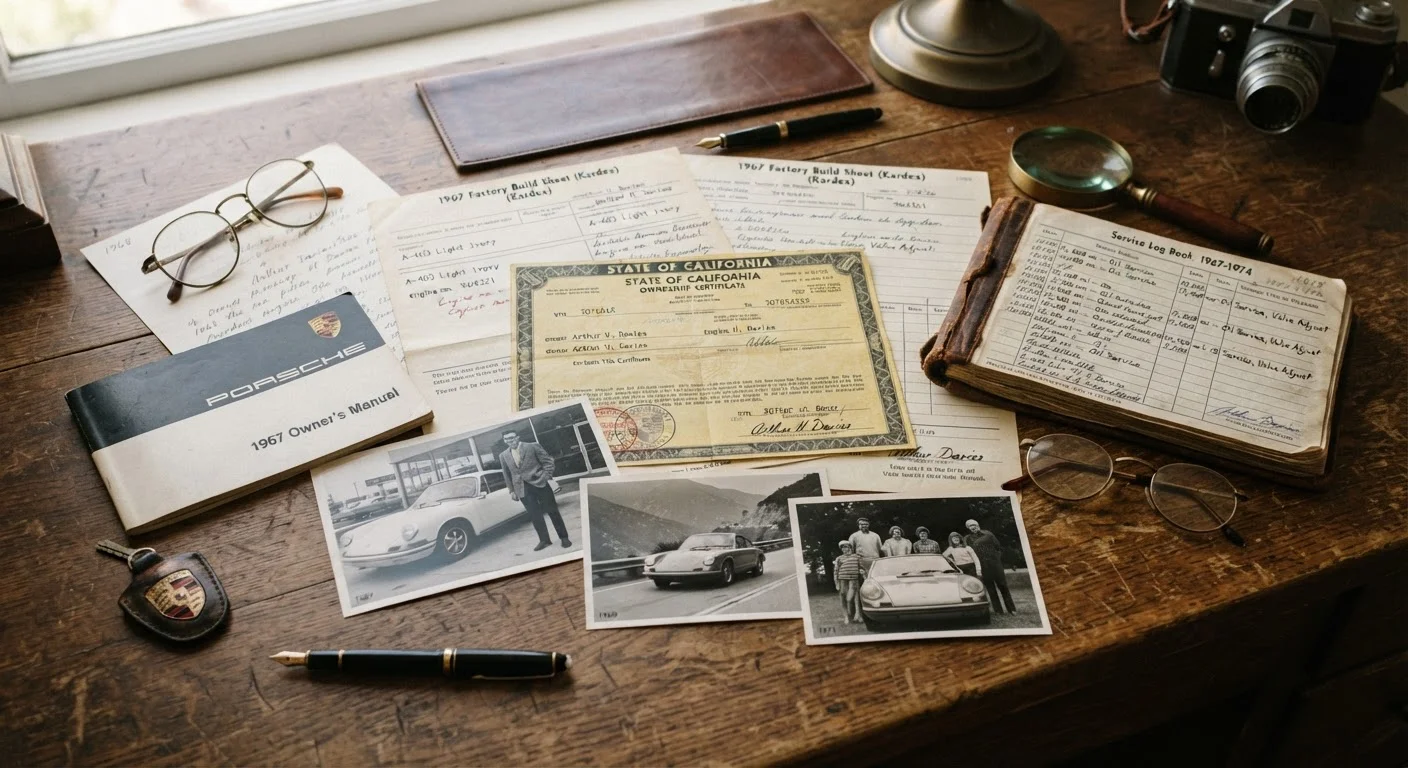
- Factory build sheet / broadcast sheet: An internal production document listing every option, color code, and drivetrain specification as ordered. Build sheets are difficult to fabricate convincingly because their format, paper stock, and ink vary by plant and model year in ways that marque specialists recognize. Build sheets and window stickers carry distinct evidentiary roles that buyers should understand before evaluating a file.
- State title with unbroken chain: Each title transfer should correspond to a traceable owner. Gaps in the title chain - particularly across decade boundaries - warrant scrutiny. Titles that list the same owner for thirty years are not suspicious; titles with unclear reassignments or altered dates are.
- Vehicle Identification Number (VIN) stampings: Factory-stamped VINs appear in multiple locations on American vehicles - door jamb, dashboard, firewall, frame rail - and the character font, depth, and spacing are model-specific. A VIN that matches across all stampings and aligns with factory records is Tier-One physical evidence.
Tier-Two Evidence: Service, Registry, and Photographic Records
Below factory documents sit records that corroborate history without having originated at the factory. Their value lies in consistency and cross-referencing.
Tier Two
Classification of dealer service records in provenance hierarchy
Service records corroborate history but are subordinate to factory-issued and government documents when weighing evidentiary strength.
Multiple locations
Factory VIN stampings on US vehicles
American manufacturers typically stamped or affixed VINs in several chassis locations; consistency across all points is a key authentication indicator.
- Dealership service records: Period receipts from franchised dealers carry substantial weight, especially when they reference the VIN, odometer reading, and a specific repair. A complete dealer service file spanning the first decade of a vehicle's life is genuinely rare and meaningfully valuable.
- Marque registry or club certification: Established owner registries - maintained by recognized marque clubs - document chassis numbers against a historical database. Owner registries and marque clubs safeguard chassis records and documentation accumulated over decades, making them an independent cross-reference that is difficult to manipulate.
- Period photographs with contextual detail: Photographs are useful only when they contain datable contextual clues - a visible license plate from the claimed era, a period-correct setting, or photographic aging consistent with the stated decade. Standalone snapshots without context add color but not proof.
- Insurance and registration documents: Annual registration renewals and insurer correspondence create a timestamped ownership timeline. Even partial records covering key transitions add meaningful links to the chain.
Appraisers and auction houses have specific documentation standards that go beyond simply presenting a folder of papers - understanding those standards before consignment avoids last-minute complications.
What Documentation Cannot Prove - and When to Involve Experts
Even a complete document file has limits. Paperwork can be falsified, reassigned to the wrong vehicle, or assembled to tell a misleading story. Documents prove what was recorded, not necessarily what occurred. A firewall-stamped VIN confirms factory identity; it does not confirm that the current engine is the original unit. A dealer receipt confirms a service visit; it does not confirm that the described work was actually performed.
For high-value acquisitions, a document file should be reviewed alongside a physical inspection by a marque-specific specialist who can cross-reference body stampings, casting date codes on mechanical components, and trim codes against factory records. Building and preserving a defensible history file is a long-term practice, not a pre-sale exercise.
Seller-Assembled Files Deserve Extra Scrutiny
A document file organized and presented by the current seller - rather than preserved by a neutral party such as a registry, insurer, or auction house - warrants careful examination. The sequence, completeness, and physical condition of each document should be evaluated independently. Consulting a marque specialist before purchase is advisable for any vehicle where documentation gaps exist or asking prices are substantial.
This article is for general educational purposes only. Valuations, document standards, and evidentiary thresholds vary by vehicle type, auction house, insurer, and jurisdiction. Consult a qualified appraiser, marque specialist, or legal professional before making decisions based on a vehicle's documented history.